
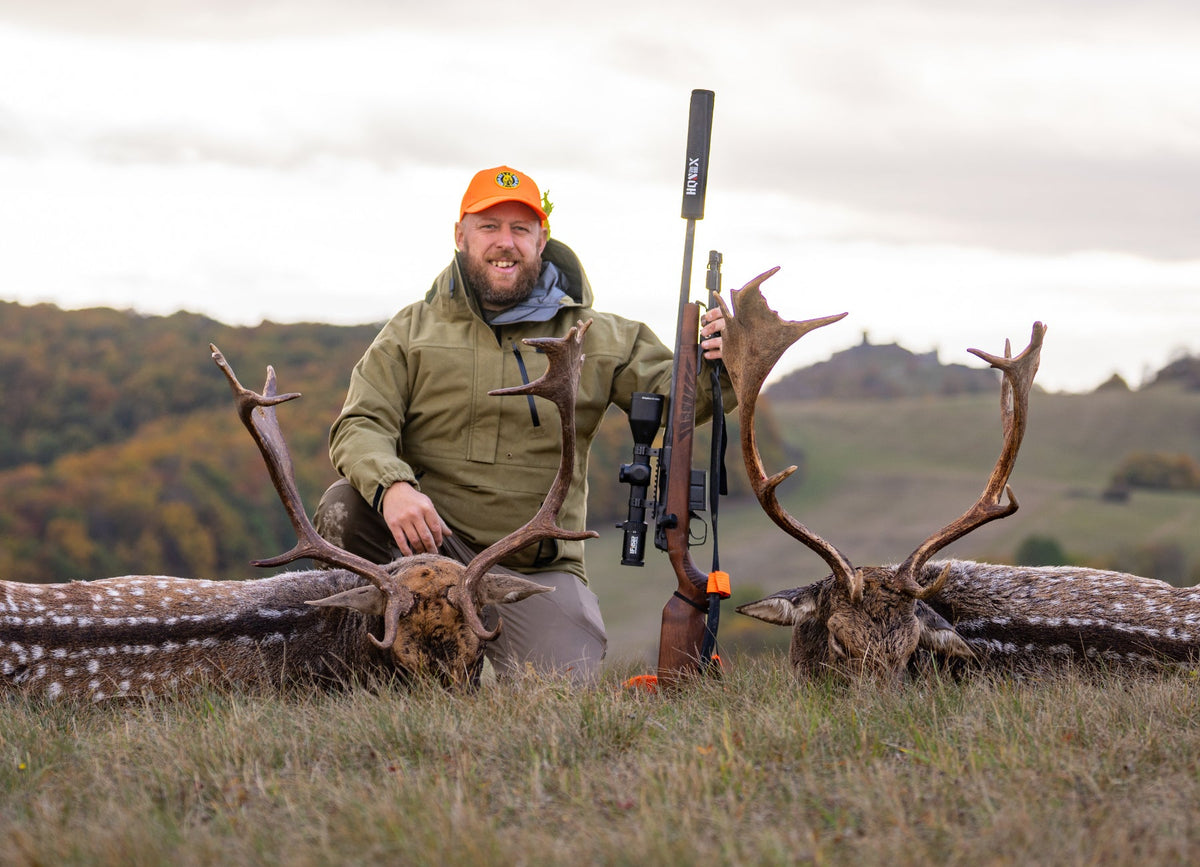
Mat Miller grew up in Makara, on the rural edge of Wellington, shooting rabbits with his dad. He trained as an arborist, taught the trade in Dunedin, and in 2015 took a job in Stockholm that was meant to last a year. He's still there, with his wife Jenny, two boys and a job filming hunts across Europe and America.
We caught up with him after the fallow rut in Slovakia. He told us about paying to hunt, why he picked up a bow, what he packs for a Swedish winter, and why Kiwi hunters should count themselves lucky. Over to Mat.
Where in New Zealand did you grow up, and how did hunting start for you?
I was born in Wellington and lived there until I was two. We moved to Nelson for Dad's work, then back to Wellington, to Karori, when I was five. We lived there for four years and then moved to a small property in the neighbouring suburb, Makara, which is a fantastic little rural area. I went to Onslow College and in the final years would ride my bike the whole way there and back each day. Cheaper than the bus, and I would also beat it by 10 minutes.
I got into hunting through my Dad. He had a shoulder mounted red stag that he had shot in Ohakune and I was infatuated with it. I also used to love looking through his old hunting photos, so you could say it was always in my DNA. We started out target shooting and rabbit hunting when I was about five or six. At the age of seven I shot my first rabbit and it was by far my favourite thing to do.

I'm the oldest of three children, and sadly once I got to about nine there was not so much time to go hunting with Dad anymore. My sister rode horses and my brother started riding motocross and later speedway. So as soon as I turned 16 I went in and got my firearms licence, and all of a sudden there was not a single goat, rabbit or possum safe in a 10km radius.
"As soon as I turned 16 I went in and got my firearms licence, and all of a sudden there was not a single goat, rabbit or possum safe in a 10km radius."
I left college halfway through seventh form to start a horticulture apprenticeship with the Wellington City Council. That developed into my love for trees and I found arboriculture. I finished my arboriculture studies in Dunedin, ended up in Christchurch for seven years, and shortly after the 2011 earthquake moved to Australia to chase the dollars and some more adventures. In 2012 I moved back to Dunedin to teach arboriculture at Otago Polytechnic, where I stayed for two years before moving back to Australia.
What took you from New Zealand to Sweden?
I was earning good money in Sydney but was a bit lost in life. A good friend reached out and said I should go to Sweden and that he could get me a job. At first I declined, but I ended up taking him up on it, and in February 2015 I landed in Stockholm, where it was -8°C. Quite the change from a 33°C summer day in Aus.
I was only supposed to be there for one year. Eleven years later, two beautiful boys and an apartment, I'm still here.
Tell us about your family. Are your boys starting to come out hunting with you?
I have two beautiful boys, Wyatt (8) and Jaxon (6). They are my world, and honestly the hardest thing about what I do is being away from them so much. But they are showing a natural interest in hunting and I am starting to take them out with me here in Sweden.
Wyatt came with me three weeks ago on a driven hunt for the first time. We had a fantastic day but sadly saw no action. He has an interest in filming and edits fun videos, which I have not provoked at all. So I asked him if he wanted to take one of my old cameras out and film for the day. His face lit up and he loved it.

Jaxon is very keen to come hunting with me and I will take him out next. He's a kid that can't sit still, so it will be more about spending time with him, and a good learning experience for both of us.
My beautiful wife Jenny works for an organisation that works with adults who have different learning difficulties. They make a TV show together where they interview famous Swedish people. She's very creative, but she also has amazing management and organisational skills, which are not exactly my strong points.
How did filming other hunters become your job?
My main passion is actually bowhunting. After shooting so many animals with a rifle, the magic had worn off a little and it became more of a process. But every time I harvest an animal with a bow, it's like shooting my first animal all over again. It's by far the most intense way you can hunt, and it's great if you like a challenge and a chance to get good at something.
I started bowhunting in about 2017. Bowhunting is illegal here in Sweden, so it was quite the mission to start. There are no good mentors around, and when it was time to actually go hunting I always had to travel to another country. That means you have to wait a whole year for a chance to correct many of the mistakes you make.

So I decided to start filming and documenting my bowhunting journey, and that is where the filming side started. I started guiding hunts in Europe, and as part of that I was filming clients and producing marketing material for myself. Then other people in the hunting industry started asking me to come and help them film, and from that moment it's grown legs and we are away running. I just got back from a six week trip in America filming for Chad Mendes.
"Every time I harvest an animal with a bow, it's like shooting my first animal all over again."
Hunting in Sweden is very different from New Zealand. What surprised you most?
Hunting in Sweden, and Europe generally, is completely different to NZ. There are almost no public grounds anywhere in Europe, so unless you are part of a hunting team, get invited by friends or own your own land, you need to pay to hunt. It was a really tough pill for me to swallow for a long time. Eventually I just had to roll with it, and honestly, letting go of my NZ ideas has led me to see some amazing places and experience some fantastic hunts all across the world. You really don't know how lucky you are in NZ until you leave.
Payment is structured differently than you might think. Usually you have a day rate or a package deal, and the costs depend on how many animals you shoot and what size trophy they are.
Everything commercially is measured against trophy size. This quickly runs into the thousands of euros, and in places like Hungary you can easily spend 12,000 euros on a top end wild stag. Then you also need to pay for the meat if you want to take it with you.

But hunting in Sweden, once you are living here, is not so bad. They do a lot of moose hunting and driven hunts, and it's all seasonal. Every animal here is part of the ecosystem, so they are all monitored. Moose, brown bear and red deer have tags that are handed out to the hunting teams or areas. Once the tags are filled, no more animals in that area can be shot.
Driven hunts are something we don't do in NZ, as far as I am aware, and honestly I am not sure how the NZ health and safety departments would feel about them. But I really enjoy them. When they are run properly, they are very safe, and it's a fun way to hunt and manage the animals.
"You really don't know how lucky you are in NZ until you leave."
What took you to Slovakia, and what were you hunting?
I have a little passion for fallow bucks, and the fallow deer rut in Europe is something everyone needs to experience. Basically all the bucks and females come together in these areas called rut pads and it's just pure warfare. The sounds are incredible, and it's a very special moment that nature presents for us to experience. Slovakia is one of the best countries in the world to experience this.

Describe the country and the conditions. What were the days like?
If you know trees, the main trees there are beech (Fagus sylvatica), and this makes for absolutely beautiful forests, especially in the fall. Lots of yellows and oranges. The first evening we went out it was abnormally warm for the time of year, at 22°C. Then over the next few days the temperature dropped hard. It also rained, and this really set the bucks off. The rain created that sticky, slippery mud that sticks to everything, but stalking was easy as the forest floor was very soft.
The Slovakians were amazing people. Some did not speak any English, but we always knew what was going on. I swear there is a telepathy that happens amongst hunters. They love to celebrate a successful hunt, which made for an extremely fun evening and a sore head the next day. If you go, make sure you ask for the authentic experience. It's worth it. The food is great as well, completely different to what we usually eat in NZ. A lot of the cooking is focused around cheese, rather than it being an ingredient, and they have a lot of nice stews and soups.
"I swear there is a telepathy that happens amongst hunters."
What moment from the trip has stuck with you most?
Honestly, just being up close to the animals in the rut pad. We snuck in and had about 10 minutes to watch them fighting and running around. Then sadly the wind switched and they all started clearing out.
What's it like to hunt and film at the same time?
Don't do it! It's so hard, and you really need a lot of luck and preparation if you are solo filming. Something nobody ever talks about is that after you shoot an animal, you can't just enjoy that moment. You need to start thinking about how to film it, what photos to take, how to take those photos, how's the light, and a million other things. But I enjoy a challenge, and when you do end up with amazing footage and a great video, it is a great feeling.

What would you tell someone heading there for the first time?
Bring some painkillers. For the hangover.
What were you wearing in Slovakia, and why those pieces?
The first evening I just had the Argali Active Long Sleeve Top on as it was so warm, and I was really happy with its temperature regulation. Even once the temperature started to drop as the sun went down, it took a long time for me to need to put the Micro Fleece on.
On the bottom I wore the Scree Pants. Lightweight and perfect for the conditions. I also really love the pockets on those pants. The zip and pocket placement is great.

The second day we had some rain and the temperature had dropped a lot, so I layered up again with the Argali, then the Micro Fleece and finally the Kagoule. This worked great because I knew the walking would be slow and we were likely to be stationary for long periods. I did not overheat and I did not get cold. The outer layer of the Kagoule is also not very loud. Considering it's a fully waterproof jacket, that's pretty hard to beat.
When I am travelling I really love wearing the Chamois Insulation Jacket. It's super lightweight and very warm, with great pockets for passports and so on.
"The outer layer of the Kagoule is also not very loud. Considering it's a fully waterproof jacket, that's pretty hard to beat."
What would you tell someone to pack for the kind of hunting you do?
This one's a bit tough, because I am in so many different countries with different temperature ranges.
• Early season: Tahr Ultralite Jacket in case of some rain, Micro Fleece, and maybe the Swazi Hood for those chilly mornings and evenings. Scree Pants.
• Early winter: Argali base layer, Micro Fleece, and then depending on the weather either the Kagoule or the Windriver. On the bottom I start heading to the Ipotane Pants, just because they are a little thicker.
• Late winter, -5°C and below: I put that layer system to good use. Argali, Micro, the Hood, finished off with a Geyser Jacket. On the bottom, long johns, Ipotane, then the 4WD Pants over the top.
Is there one piece that's earned its place more than the rest?
So far, I have a soft spot for the Hood. It reminds me of NZ, and every time I put it on I get flashes of the NZ bush. It's something I wear around with great pride.
"Every time I put it on I get flashes of the NZ bush."
Where are you headed next?
I have a driven hunt here in Sweden, then I go to Ireland for the first time to chase reds, sika and their wild goats. I am really looking forward to that, and of course I need to try a Guinness, right? After that I fly out to Pennsylvania to chase some whitetail with the bow with my good friends. It's a trip I look
forward to every year. Then I have some more driven hunts in Sweden, as well as a charity hunt for Ronald McDonald House, which I am heavily involved in.

The final big hunt of the year for me will be a huge five-day driven hunt in Turkey for wild boar. I did it last year and I can't wait to go back. You need to see it to believe it.
Anything else you'd like people to know?
I am super approachable and happy to help anyone out. If anyone wants to come and experience Europe, let me know. I will be in NZ from mid March to the end of April 2027 for my own filming projects. Very much looking forward to being home.
That's Mat. A long way from Makara, still happiest in the bush with a bow or a camera, and usually both, against his own advice. Whether you hunt the New Zealand bush or a Scandinavian forest, drop him a line. He means it about being approachable.
Follow Mat: @matmillerhunter on Instagram, @Mat-Miller on YouTube


Share:
Swazi Ambassador Spotlight: Johan Kvorning