
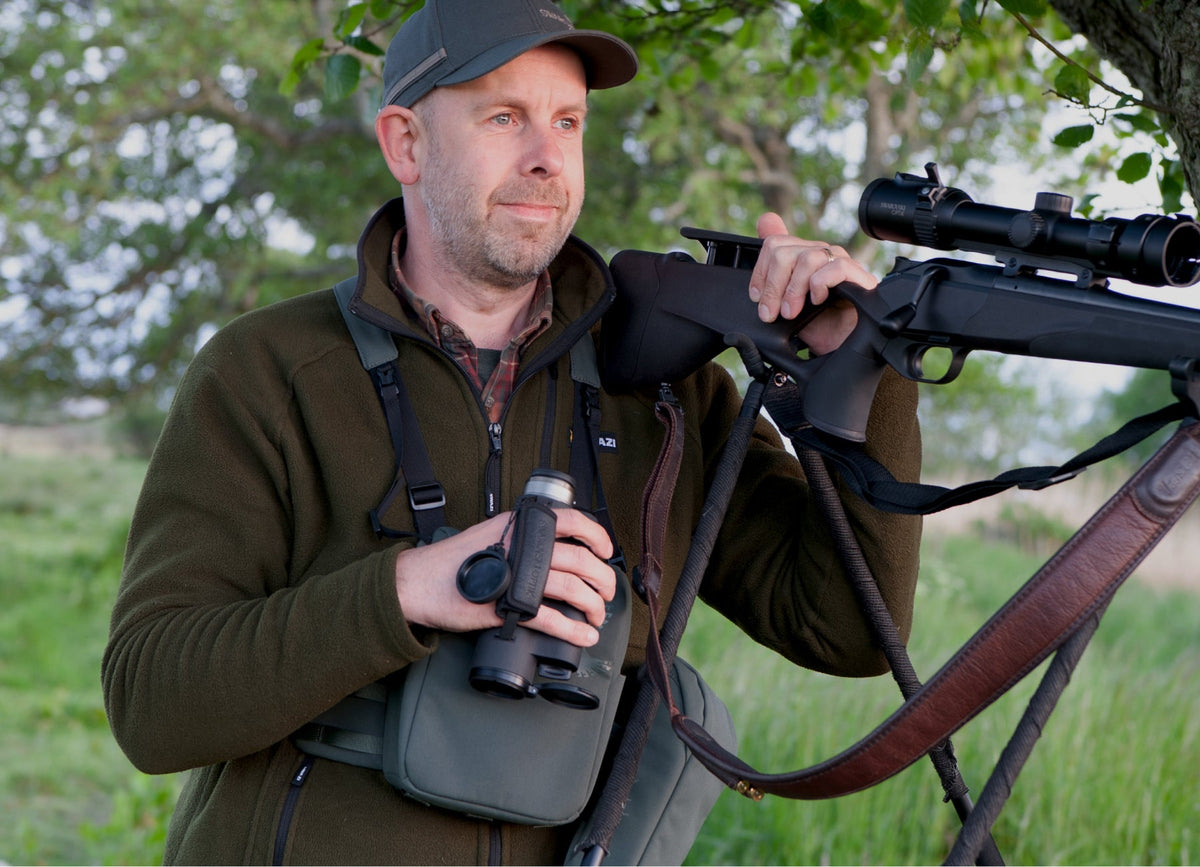
Sweden's hunting culture runs on working dogs. Bay dogs holding boar, scent hounds pushing game towards the stands, dachshunds circling roe deer quietly through the beech woods. It's a tradition built on patience and passed down through generations, and Johan Kvorning lives right in the middle of it. A hunting photographer turned hunter, Johan spends his year on wildlife management, driven hunts and protecting the wader reserves around his home in Varberg, usually with his twin boys, Oscar and Axel, not far behind.
We asked him about Swedish dog culture, the hunt his sons won't let him forget, and why gear all the way from New Zealand feels so at home on Sweden's west coast. Over to Johan.

Tell us a bit about yourself: where you live, what you do, and how you got into hunting.
I live in Varberg on the west coast of Sweden, an area shaped by the sea, the woods and above all our big beech and oak forests. I started hunting about 14 years ago, but I actually came to it through the camera. For years I photographed hunts for a Swedish hunting magazine and for several hunting clubs.
Who taught you to hunt, and what's the most important thing they passed on?
I've been lucky enough to hunt, and still hunt, with a lot of very skilled hunters. Some of my mentors brought their own children along, and that inspired me more than anything.
Hunting isn't something I got from my parents or relatives. It's a passion that grew on its own, and it keeps growing.
What does a typical hunting season look like for you?
For me the season never really ends. It just changes shape. I work with predator and wildlife management, both for the County Administrative Board and locally where I live. The highlights of my year are seal hunting, driven hunts and the yearly trip to my German friends outside Frankfurt.
In recent years, protecting breeding waders in our local bird reserves has become a big passion of mine. We do that by keeping predator numbers down in those sensitive areas.

“For me the season never really ends. It just changes shape.”
What do you mostly hunt, and where? Tell us about the country around Varberg and west Sweden.
Varberg lies right on the coast with big forests behind it, so the countryside near town is open, with crop fields and meadows. Drive ten minutes east and you're in large, wild forest with good numbers of wild boar, roe deer and moose, and more and more red deer.
Hunting in Sweden is very different to New Zealand. What would surprise a Kiwi hunter most about how it's done there?
I've never been to New Zealand, although going there is a dream of mine. What I imagine would stand out most is how much we rely on dogs.

Traditional Swedish hunting is built around working dogs, whether it's a bay dog holding game in place or a scent hound pushing it towards the hunters on stand. That dog culture runs deep here, and I think it would surprise a Kiwi more than anything else.
What are the toughest conditions you hunt in, and what do they demand from you and your gear?
On the west coast the wind hardly ever stops. This far north, temperatures can drop fast and the weather can turn without warning. My gear has to cope with long, hard hours in the field and keep me dry and warm the whole time.
Do you hunt with dogs? Tell us about them: breed, names, and what they do in the field.
I don't have dogs of my own, but many of my close friends run some of the best hunting dogs in Sweden. There are a lot of hunting trials here, and this autumn the Swedish Dachshund Hunting Championship is held right here in Halland. A friend of mine won it last year with his dog Ruffa.

Here the dachshund is mainly used for roe deer. It's a slow, steady scent hound, so the roe deer doesn't run off at full speed but circles quietly within its home range. That makes for a really exciting hunt. We also have excellent boar dogs that bay and hold the boar, and dedicated tracking dogs that follow up wildlife injured in traffic collisions.
Swazi is proud to sponsor a day at the Swedish Dachshund Hunting Championship (Tax SM) this year. What does the championship mean to the hunting community in Sweden?
In Sweden, hunting with dachshunds is much more than a sport. It's a big part of our hunting heritage. The championship is the real test of stamina, tracking and calm, steady driving work in tough Nordic terrain. For hunters here it shows the best working bloodlines, and it honours the dogs and handlers who spend day after day in the wet, cold autumn woods.

Having an outdoor brand like Swazi backing our community and these hardworking teams means a lot to everyone who keeps the Scandinavian working dog tradition alive.
“In Sweden, hunting with dachshunds is much more than a sport. It's a big part of our hunting heritage.”
Tell us about a hunt you'll never forget. What made it so memorable?
One hunt I'll never forget is sitting on a stand with my two sons. They were quite small then, so my only goal was to give them a good day outdoors. I didn't expect to see much game, since two little boys aren't famous for keeping quiet in the woods. At the stand we set up their backpack chairs and unpacked our fika, which that day meant sandwiches and hot tea. It was cold and damp, so we lit a small fire.

Suddenly all three of us saw a moose cow cross an open gravel road with her calf right behind her. As I got ready to take the calf, one of the boys whispered, “No Dad, take the bull.” I had completely missed a big bull stepping out further back. He walked past us at about 50 metres and gave me a clean shot.

Later that day the boys helped the rest of the hunting team process the moose. It's still one of my best hunting memories, and the trophy hangs on the wall in my son's room.
What's the best thing you've ever seen or experienced in the Swedish outdoors?
That's almost impossible to answer. The Swedish forest is part of who I am, and it's where I go whenever I need to recover or just be present. Being able to hunt across such varied country is a privilege I never take for granted. The forest has been central to my life since I was a child, and it's where I feel most at home.
“One of the boys whispered, ‘No Dad, take the bull.’ I had completely missed a big bull stepping out further back.”
Tell us about your sons. How do you spend time together outdoors, and what do they love doing most?
I have twin boys, Oscar and Axel, who have been coming outdoors with me since they were tiny. Their first real hunt, when we took a roe deer, was when they were only three. Apart from that they've spent countless hours helping me feed wildlife, check traps and roam the woods.
People often ask how I got them so into hunting, and why they still want to come along. I think it comes down to always inviting them and never pushing. I tell them what we're planning and leave the decision to them. I've never once forced them out on a hunt or made them do winter chores.

Another rule is to always pack spare clothes, because kids get wet. Even on a bone dry day they'll find the only stream or mud puddle in the whole forest. When they're with me, hunting comes second. If they get tired or restless, we change plans, explore or build something. Sometimes luck finds us anyway and we end up in the right spot to take game or follow the dog handlers. And as on any good day outside, plenty of fika, enough food and good gear make all the difference.
What do you hope those days outside teach them, and what have you learned from seeing it through their eyes?
I'm fairly sure that, like me, they'll always love being in the woods. Whether they end up hunting or not doesn't matter much in the end. But when I listen to how they talk and the questions they ask, and see how they behave out there and how much they already know, I think they'll carry the tradition on and maybe one day bring their own children along. That thought makes me very happy.
Having the boys with me slows everything down and lets me see nature through their eyes. All the questions that pop up along the way make every trip worth it.
“I think it comes down to always inviting them and never pushing.”
How did you first come across Swazi, a brand from the other side of the world?
I bought The Hood many years ago and wore it more or less every day for weeks. Later, when I needed a proper heavy duty jacket, I found one of their anoraks. After that my kit just kept growing, because the garments last and take whatever punishment you throw at them.

Which piece of Swazi gear do you reach for most, and why has it earned its place?
It's hard to pick just one because I have a lot of favourites, but if I have to choose, it's the Sentinel Ultralite. It's a great jacket that I wear both hunting and in everyday life. I spend a lot of time around birdwatchers and members of the public, and in this jacket I fit in without looking tactical.
What I like most is how packable it is. It takes up almost no space, so it's always my extra layer on long, hard days outside.
Why do you think Swazi works so well in the Swedish hunting and outdoors environment?
New Zealand may be on the other side of the world, but I think our weather throws much the same at us. Swedish hunters dress in layers and finish with a windproof or waterproof shell that still breathes well. That's exactly how Swazi builds its gear.
“New Zealand may be on the other side of the world, but I think our weather throws much the same at us.”
If you had a free day tomorrow and perfect weather, where would we find you?
Out in the forest. Ideally with good friends, listening to a good hound working game through the woods.
One piece of advice for someone just starting out in hunting?
Never be afraid to ask for help, and stay curious. If you don't hunt yet, just ask a hunter if you can tag along. I can almost promise nobody will say no.
Once you decide to start, live by one rule: buy quality, cry once. Skip the cheap gear, save a little longer and get proper equipment from the start. Otherwise, you'll regret it and end up replacing things after a few weeks or months because they let you down.
And if you ever want to join me in the field, get in touch. If I can't host you myself, I have plenty of friends who would gladly take you out in the Swedish woods.
What's one gear opinion you'll never change your mind on?
Buy quality, cry once.
That's Johan. Patient, curious and generous with his time, whether he's showing two small boys a moose crossing a gravel road or offering a stranger a seat on his stand. It's Swedish hunting at its best, built around good dogs, good company and plenty of fika, and we're proud Swazi has earned a place in his kit. If you're ever near Varberg, take him up on that offer.
Follow Johan: @johan_kvorning


Share:
Swazi Stories: Zoe and Nick Mulligan in Fiordland