
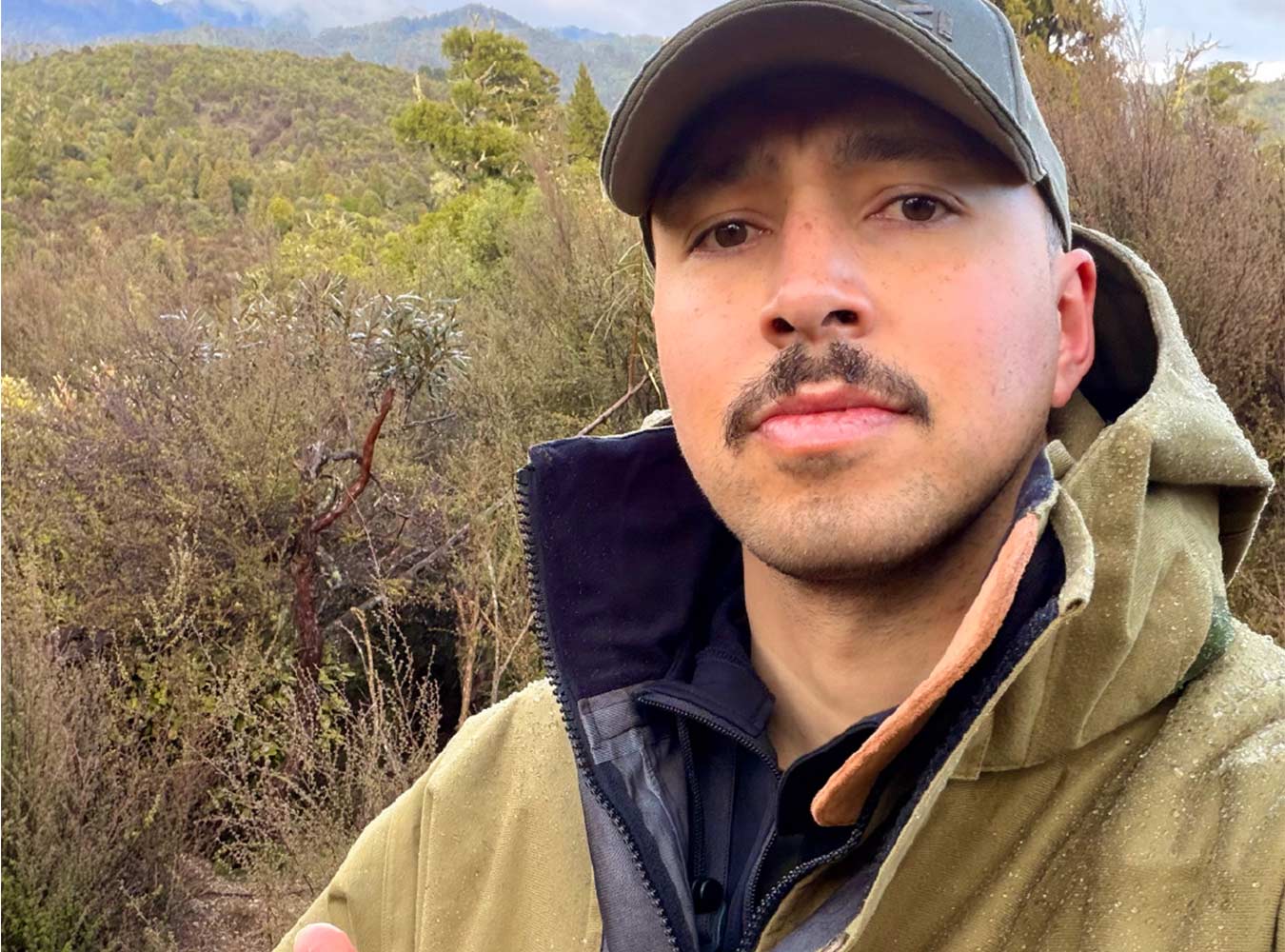
Meet Shaquille Graham, hunter, father of three daughters, and the man behind Boar & Buck. Based in Rotorua, you'll find Shaq each week chasing deer and running pig dogs across the central North Island - from the iconic Kaingaroa pine forests to the region’s rugged native bush.
It’s the central North Island Shaq calls home - a region with one of the highest concentrations of hunters in New Zealand, yet a side of Kiwi hunting life that doesn’t always get the spotlight. Alongside a lifetime in the bush, Shaq is completing a PhD in Public Health while working in the health sector, bringing a rare mix of practical hunting experience and professional purpose. Everything for Shaq flows from family. Today, his greatest privilege is introducing his three young daughters to the outdoors and passing on the intergenerational principles that shaped him growing up - “provision, stewardship, and pursuit”. For him, the greatest hunting success for his daughters won’t be measured by the animals harvested, but by the character, gratitude, and love for creation they carry into the next generation.

For anyone who hasn't come across you yet, tell us a bit about yourself and Boar & Buck Aotearoa:
Ko Shaquille Graham tōku ingoa, he uri ahau nō ngā waka o Te Arawa, Tainui me Aotea. My name is Shaquille Graham. Before all else - a man of faith, a husband to my beautiful wife, a father to three beautiful daughters (all under 4 years old), and an ordinary Kiwi hunter. Boar & Buck as a small social media platform is just an extension of who we are and what we do - growing out of an overflow to share our love and passion for hunting & the outdoor experiences that shape our lives. Principled upon provision (kai gathering and kai sovereignty), stewardship (caring for our environment & all that's within it), and pursuit (the art & beautiful science of hunting deer and pigs). Boar & Buck enables us to showcase the every-day hunting lifestyles of my family and community in the beauty of primarily our Central North Island landscapes.
You show a side of hunting (pig dogs, thick North Island bush, forestry blocks) that doesn't always get the spotlight compared to high-country and alpine hunting. Why was it important to you to represent that?
That’s simply the hunting world we grew up in. We’re from Rotorua, in the heart of Te Arawa and the central North Island—a region synonymous with bonnet hunting, some of the Southern Hemisphere’s biggest pine forests, rugged native bush, New Zealand’s fastest running pigs, thick blackberry, and an incredible diversity of deer species (Red, Rusa, Fallow, Sika and Sambar). It’s home to one of the highest concentrations of hunters in the country, yet our style of hunting doesn’t often receive the same front-page attention as our iconic Southern alpine landscapes. Boar & Buck has always been about representing our slice of Kiwi hunting culture. From carpeted bonnets and pig dogs to supplejack, blackberry, expansive pine forests, long nights behind the thermals, and hard days in our thick native bush—this is the hunting life that shaped us. It’s authentic, it’s uniquely Central North Island, and it’s a story we’re incredibly proud to tell - a story that existed long before us and, God willing, will continue long after we’re gone.
What does a typical week of hunting look like for you?
They say “Saturdays are for the boys”, but Saturdays seem to be for the girls in our household. Most weekends you’ll find us—my wife, our three daughters, the dogs and me—loaded into the flat-deck Navara. It’s the usual - BP fuel stop, coffee and pie combo by 5:30am, bonnet hunting by daybreak, then going dark to dark through our pine forestry chasing running pigs with a ute full of children’s car seats. You definitely can’t forget the mandatory two-minute noodle stop at lunchtime—the countdown starts about an hour beforehand! Across the rest of the week, amongst work, family life and everything else, we usually squeeze in one or two mahi kai (food gathering) missions, often spending long nights behind the trusty Pulsar thermals chasing venison. One of the great privileges of living in the central North Island is having such diverse hunting opportunities right on our doorstep. Within a short drive we can hunt Red, Sika, Sambar, Rusa and Fallow deer across an incredible variety of country, and I hope that it is something that I’ll never take for granted.

You're a dad to three girls. When did you start bringing them into the hunting life, and what does that look like day to day?
My wife and I were both introduced to hunting from a young age. I grew up primarily deer stalking with my Dad and wider whānau, while my wife cut her teeth pig hunting from push-bikes with her Dad and sisters. As you’d expect, having our girls involved in hunting and the outdoors has simply been an intergenerational norm that we’ve carried over from our own childhoods without much thought. All three of our daughters have spent long days bonnet hunting with Mum and Dad since they were just three months old. The beauty in it all has been watching how time in the outdoors, even at such a young age, has already begun shaping their character—grounding them as children, nurturing their curiosity, and giving them a simple yet deeper appreciation for life, creation, and where the food on our table comes from.
What do you hope your girls take away from growing up around hunting and the outdoors?
More than anything, I hope they grow into women of strong character and resilience. I hope they understand where food comes from, appreciate the value of hard work and dedication, and learn that provision doesn’t simply appear on a supermarket shelf. I want them to appreciate that the patty in a Big Mac comes from something that once had breath in its lungs—that food is a gift, and one that should never be taken for granted. I want them to respect animals, care deeply for creation, and recognise that everything we have is ultimately a gift from God. If they choose not to hunt when they’re older, that’s completely okay. Hunting and its trophies have never been the end goal. Character is. Hunting is simply one of the greatest classrooms I’ve known for cultivating resilience, humility, gratitude and a deeper understanding of life. If the outdoors helps shape them into women who love people, value creation, and carry those qualities into whatever path they choose, then it’ll have done exactly what I hoped.
Hunting's been part of your life since you could walk. What did it teach you growing up that you now try to pass on to your own kids?
The bush has been one of my greatest teachers. It taught me patience because nature can’t be rushed. Perseverance because success often comes after failure. It taught me that time in the saddle is what truly hones skill. Humility because the bush has a way of reminding you that you’re not in control, and a deep appreciation for life and the sobering responsibility that comes with taking it. It also taught me to appreciate the simple things—a good, honest dog, a New Zealand sunrise, mates who have your back, a well-maintained rifle, a drink of water when parched, and a full freezer after a hard-earned carry out of the bush. Those lessons have shaped far more than the hunter I’ve become - they've shaped the person I am today. If my girls remember one thing from growing up in the outdoors, I hope it’s those lessons - rather than any particular animal we ever harvested or a trophy set of antlers hanging on their Dad’s wall.
You've spoken about hunting sitting at the centre of your faith, family and provision. What does that actually look like in practice?
For me, hunting has always been one of the places where I feel closest to God, closest to my family, and most appreciative of the life we’ve been given. That’s why hunting has never been about harvesting animals as much as it has been about stewardship of creation. For me, hunting isn’t about taking from creation; it’s about participating responsibly within it. My faith holds that humanity has been entrusted with the stewardship of creation, and I believe hunting is one way of faithfully honouring that responsibility. It’s harvesting food ethically, respecting the animals we pursue, honouring the taking of life and the provision it brings for family and friends, wasting as little as possible, and recognising that every successful hunt is ultimately God’s provision. Both my faith and culture have always taught that mahi kai (food gathering) was never meant to stop at filling our own freezer. It has primarily always been about providing for others. “Nā tō rourou, nā taku rourou ka ora ai te iwi” — “With your food basket and my food basket, the people will thrive.” Some of my greatest hunting joys have come from sharing wild game with whānau, mates, tangihanga, marae and community events, church whānau, and others simply in need. When I’m in the bush, I’m reminded that I’m not the owner of creation—I’m simply a caretaker, enjoying what God has already made and grateful to share in His provision with others. Provision was never meant to stop with us.

Between hunting, fatherhood, and a PhD in Public Health, how do you balance it all?
If you asked my PhD supervisor—or my wife—they’d probably both tell you the same thing… not very well! But in all honesty, some weeks I don’t. Life’s full, and there are definitely seasons where something has to give. What keeps me grounded is remembering my priorities. God first, then my wife and daughters. Everything else has to find its place after that. I’ve learnt that balance isn’t about giving everything equal time. It’s about giving the right things priority in the right season, and being content knowing that not every season looks the same.
What Swazi gear do you rely on most out there, and why does it work for the country you hunt?
The country we hunt demands a layering system rather than one piece of gear. A frosty Central North Island morning can quickly turn into sideways rain that turns into a warm afternoon, so your gear has to adapt with you. I’m almost always in Swazi’s merino base layers—they’re the foundation of every hunt through all weather. The Windriver is probably the jacket I wear most, whether we’re bonnet hunting pigs on a frosty morning or heading into the pines. It’s light, blocks the wind brilliantly, and breathes well when you’re on the move. When the weather really turns, the Wapiti XP has been my staple for years. It’s quiet, fully waterproof, and, in my opinion, the world’s best all-round hunting jacket. The Geyser paired with a Hasbeanie is hard to beat on those freezing mornings, or on the back of the ute, through the long nights behind the thermals. The 4WD pants are my everyday hunting pants. They handle blackberry, supplejack, thin to waste, and everything else the Central North Island throws at them, while still being comfortable enough to wear all day. What I appreciate most about Swazi isn’t any single piece of gear - it’s that the gear is designed by people who genuinely understand New Zealand hunters and New Zealand conditions - simply, quality that's fit for purpose. Good gear doesn’t make you a better hunter, but it does let you focus on the hunt instead of fighting the conditions, and that’s exactly what Swazi has done for me.

What would you say to other dads who want to get their own kids out into the bush but aren't sure where to start?
Just start. You don’t need the latest gear (although my wife would probably say I’m the wrong person to be giving that advice!), the perfect block, or a big adventure planned. Some of the moments my girls love most have been the simplest ones—watching the sunrise from the bonnet, listening to the birds wake up, sneaking the dogs some of their snacks, or sharing a pie on the way to the bush. As dads, I think we can put a lot of pressure on ourselves to create these unforgettable experiences, when in reality our kids are just excited to spend time with us. Slow the pace down, let them explore, ask a hundred questions, get muddy, spill food through the truck, and don’t worry if the hunt doesn’t go to plan (a good reminder for me too!). If they leave wanting to come back next weekend, you’ve already won. At the end of it all, my ultimate goal isn’t to raise great hunters. It’s to raise daughters who love God, cherish His creation and all that’s within it, value family, and aren’t afraid to grit their teeth and put one foot in front of the other when life gets hard. For our family, hunting is simply the vehicle that helps shape those things—and that’s worth every early morning and every $3-a-litre tank of diesel.
Anything else you'd want Swazi customers or your followers to know about you or Boar & Buck?
Boar & Buck has never been about us. Although we’re only a small platform, it’s always been about telling authentic stories that reflect the hunting culture we were raised in and the values that have shaped us. It’s never been about the following, the likes, or the influence. If people remember anything from what we do, I hope it’s not the animals we’ve harvested, but the people we’ve shared the journey with. Hunting has given me incredible memories with my dad, father-in-law, wife, mates, nephews, cousins and now my three daughters. Those are the real trophies worth holding onto.
More than anything, we want to encourage people to get out there, enjoy the places we’ve been entrusted with, appreciate New Zealand’s world-renowned landscapes, fill a freezer when they can, share that blessing with others, and leave the outdoors in a better state than they found it. If Boar & Buck encourages even one family to spend more time together, one hunter to share more generously, or one person to appreciate God’s creation a little more deeply, then I’d say we’re doing exactly what we set out to do. Provision, Stewardship, Pursuit.



Share:
Swazi Ambassador Spotlight - Joe Franklin
Swazi Ambassador Spotlight - Jared Matthews