
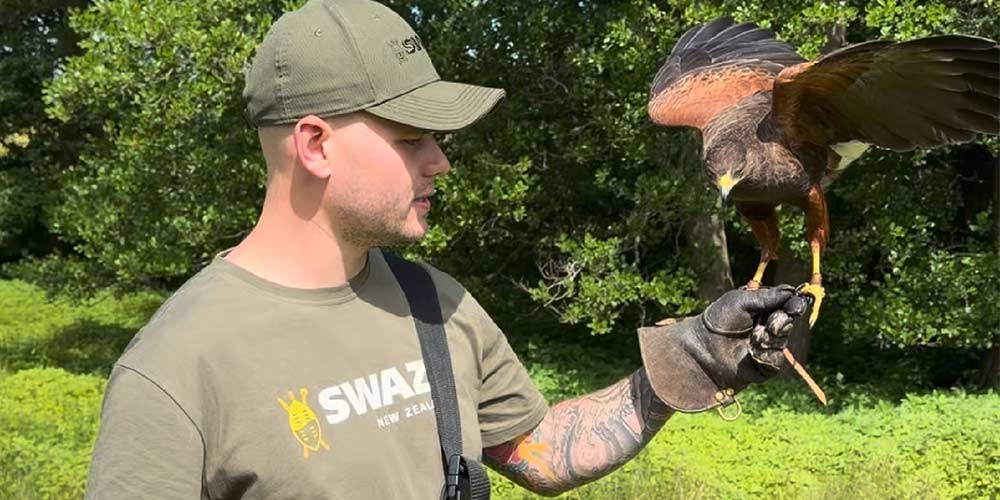
 The Bird That Started It All
Joe Franklin has been obsessed with falconry since he was seven years old. It started the way the best things do. By accident. A kestrel landed on the roof of his family home. His dad told him you could keep birds of prey. That was it.
"There's not a day gone by since then I've not thought about falconry," Joe says. By the time he was thirteen, he had his first bird. He hasn't stopped since.
But falconry wasn't just something Joe discovered on his own. The roots go deeper than that. His grandfather, a man who grew up with little, used to head out with ferrets and shotguns to put food on the table. Rabbits for stew, caught the hard way. That ethic passed to Joe's dad, and then to Joe. When he discovered falconry, he saw it as a natural extension of the same thing: going out into the field, working with nature, bringing something home.
"I realised you can do this with birds of prey. That's the route I took into field sports."
What a Bird Teaches You
Russell was a Barbary falcon, one of three brothers Joe and his colleagues were training for public demonstration. The other two took to it quickly. Russell didn't. Where his brothers adapted and flew almost immediately, Russell was timid, nervous, and slow to trust.

"It was a bit difficult watching Russell not make the progress his brothers were making," Joe says. "But it taught me loads. I had to get into that bird's head. I had to find out what made him tick."
Joe slowed down. He stripped things back to basics. He built the training around Russell rather than expecting Russell to fit the training. It worked. Russell became not just one of Joe's best birds, but the best falcon he has ever flown.
"He taught me so much more patience than what I thought I needed. The most humbling thing falconry has taught me is that it doesn't always go to plan."
The Midnight Hilux
Joe's path into deer stalking wasn't planned. He was out lamping at midnight, lying on the ground in the dark, letting his hawk feed on a rabbit it had just caught, when he heard a vehicle approaching. A Hilux pulled up. A window went down.
"What on earth are you doing lying on the floor?"
The man in the truck was a pest controller, out on the same farm for his own reasons. When Joe explained what he was doing, the man climbed out to have a look. He was fascinated. Joe returned the curiosity. When the conversation turned to deer stalking, he asked if he could come along.

"He said yeah, sure. We went out the following day. He shot a deer, showed me how to gralloch it, showed me how to skin it and we made some burgers."
That man is now Joe's mentor. He's still learning, still getting out with him as often as he can, working his way toward taking his own deer for the table.
He sees the two pursuits as closer than most people would expect. Falconry and deer stalking are both built on the same foundation: respect for the quarry, patience, and the understanding that it's not about how much you take. It's about how well you do it.
"It's not about going out and killing as many things as possible. You're managing them. The same when we go out with the hawks. I'm engineering a flight that's fair for the quarry and for the hawk."
The Rabbit That Got Away
Joe is asked for a moment in the field that's stayed with him. He doesn't pick a great kill. He picks the one that got away.
They'd been out for half an hour. His bird went down and caught a rabbit near a hole in the ground. Joe ran over, through thick cover, bramble, the lot, and reached the scene just as things got complicated. The rabbit had one leg down the hole. Joe had the other leg. The hawk had a firm grip on the far side. A tree branch sat between them.

As Joe shifted his grip to pull the rabbit free, the hawk did the same. For a split second, neither had hold of anything. The rabbit was gone.
"I wasn't mad about that," Joe says. "Falconry is about survival of the fittest. That rabbit got away to tell the story. It got away from a human and a hawk, and it'll breed strong offspring. Next season, me and my bird can have better flights, more sporting flights."
It's the story he tells more than almost any other. Because it's the one that says everything about why he does this.
Gear & Swazi
The same mentor who introduced Joe to deer stalking also put him on to Swazi. He'd watched him wear it in all conditions, out on the hill, in the thick of it, and figured if it was good enough for someone with that much time in the field, it was worth trying.
"My mentor wears loads of this brand so I thought I'll try some Swazi," Joe says. "Ever since I've tried it I've absolutely loved it. It's pretty much all that I wear now."
For Joe the requirements are straightforward: mobility, durability, and protection from the elements. When a bird catches something two fields away, he needs to move fast through thick cover, bramble, nettles, whatever's in the way, and get there before anything goes wrong. The wrong kit costs you time, and in the field time is everything.
Being Part of Nature
A perfect day, for Joe, is simple: get out with the hawk, the dog, and the ferrets. Get everyone home safely. Everything else is a bonus.
For people who've never spent time in the field, he has one thing he wants them to understand.
"It's not about going out to kill something. It's about being a part of nature. It's about watching a bird do what it would naturally do in the wild, and just being there amongst it. It is something really beautiful when you're out there."
Follow Joe's world on Instagram at @franklinfalconry and @franklinsfishing, or head to his YouTube channel, Franklin Falconry, where you'll find everything from falconry in action to learning the ropes of deer stalking. Well worth a watch.



Share:
Retailer Feature | Saran — Hamills, Taupō
Swazi Ambassador Spotlight: Shaquille Graham